
News
A Promise Kept: Raphael Adu Empowers Bokuruwa Students Through Neatness Initiative


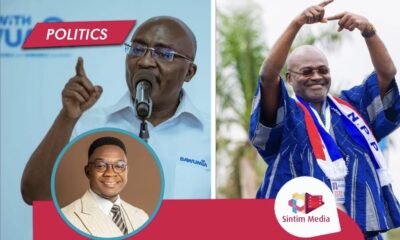
Dr. Bismark Odum-Sackey, a renowned lecturer and communications expert at the University of Education, Winneba, has analysed the political campaign communications of Dr Bawumia and Hon Ken Ohene Agyapong ahead of the NPP Presidential Primaries in his second research article.
The article, published on Graphic Online on Sunday, 25 January, examines who is effectively converting their messages into votes.
In my previous article, “Dr. Bawumia and Kennedy Agyapong in the Communication Battlefield,” I examined how the source factor is shaping the campaigns of Dr. Mahamudu Bawumia and Kennedy Ohene Agyapong.

Dr. Bismark Odum-Sackey PhD, Communication Expert/Lecturer – UEW
In this article, I shift attention to another critical element of the contest: messaging.
The Messaging
As indicated in my previous article, this analysis is based solely on selected videos of the two candidates. I relied exclusively on videos posted on the Facebook and TikTok pages of the candidates. Dr. Bawumia has verified Facebook and TikTok pages. Kennedy Agyapong, on the other hand, does not appear to have verified accounts on either platform; therefore, I relied on the pages with the highest following, which are widely portrayed as his official accounts.
I selected posts beginning 29 July 2025, when the NPP officially opened nominations for party members desirous of contesting to become the party’s presidential candidate. All videos posted on their respective Facebook and TikTok platforms within this period were watched and analysed.
In analysing a message, one may consider several approaches, including fear appeals, use of metaphors, message formats (e.g., statistics versus narrative), message balance (e.g., one-sided versus two-sided arguments), message framing (gain versus loss framing, relative versus absolute risk framing), message order (e.g., sequential request strategies), and the specificity of a message’s call to action (explicit versus implicit).
For this analysis, I examined the messages through four approaches:
peripheral, evidential, linguistic, and sociocultural. Across these approaches, I considered factors such as order of arguments, one-sided versus two-sided messaging, type of appeal, and explicit versus implicit conclusions.
Peripheral Approach
The peripheral approach focuses on packaging content in ways likely to appeal to the target audience. This includes the use of colours, fonts, pictures, images, and other visual elements that resonate with the audience.
In terms of packaging, Dr. Bawumia appears more deliberate. His pages are saturated with carefully selected campaign-tour videos and professionally curated images. Most of the videos take a documentary form and are well presented, featuring appealing voiceovers, commentaries, and interviews by Jefferson Sackey. The camera angles, sequencing, and overall flow speak volumes about the level of intentionality invested in the production.
Additionally, branding elements, such as backdrops, placards, and other campaign materials, reinforce this deliberateness. Content consistency is also evident, as most posts on Facebook are replicated on TikTok.
Kennedy Agyapong, on the other hand, does not have verified pages, but several accounts on both platforms are portrayed as his official pages. These pages are similarly saturated with pictures and videos of his campaign tours. Notably, his team also uses countdown-to-election artworks containing excerpts of his messages—an approach not observed on Dr. Bawumia’s pages.
Overall, when it comes to content packaging, Dr. Bawumia’s campaign appears more attractive and better branded than that of Kennedy Agyapong.
Evidential Approach
The evidential approach seeks to enhance the perceived relevance of issues by presenting evidence and facts to support claims. This is basically what you are telling your audience and the facts behind what you are saying.
From a communication standpoint, the messaging dynamics of the 2023 elections and the upcoming contest are different. In 2023, the NPP was in power, and the messaging focused on who could help maintain power. Following the party’s defeat in 2024, the question has shifted to who can help the party return to power.
As the immediate past flagbearer, Dr. Bawumia is expected to persuade his audience by explaining why he deserves another opportunity to lead the party. His messaging should therefore build hope, restore confidence, give assurance, and energise the base.
This requires a campaign that is not only visible and attractive but also substantively reassuring.
Kennedy Agyapong, having never contested as a presidential candidate, is expected to persuade the audience by explaining why change is necessary, why Dr. Bawumia should be replaced, and why he is the right alternative to return the party to power. This naturally requires critique, contrast, and the presentation of new and convincing ideas.
Based on these expectations, my analysis reveals notable lapses in Dr. Bawumia’s messaging. In many of his documentary-style videos, there is a heavy reliance on third-party endorsements, where supporters speak on his behalf and explain why they support him, under a slogan dubbed “Three (3) Reasons Why I Support Bawumia.” While third-party endorsements are valuable, in the current electoral context they are insufficient on their own.
Dr. Bawumia’s direct speaking time in these videos is often short and does not sufficiently address the critical questions confronting his candidature. His campaign theme, “Our Journey Together,” and his messages largely focus on unity, party history, gratitude to President Akufo-Addo, and the constituency-based budgeting system. These themes, though important, appear misaligned with what the current audience may be expecting from him.
For instance, in a video from the North East Savannah tour, Dr. Bawumia stated:
“There is a sense of pride and a sense of recognition that this is a man we want to vote for. It’s not because he is from the North. After all, if they wanted a regional leader, Dombo should have been leader, or Malik Alhassan in ’98, or Aliu Mahama in 2007. They did not support them; rather, they supported Kufuor and Akufo-Addo… They will assess you, and if they say you deserve the leadership, they will support you.”
Similarly, during a Greater Accra tour, he remarked: “Looking at the outcomes in Ablekuma Central, Odododiodoo, Ablekuma North, and many other places where opposing factions have come together to support my candidature, it has been heartwarming… Unity or lack of it was one of our problems in the last election, and one of the reasons we lost some seats in 2024.”
Kennedy Agyapong relies far less on third-party endorsements. In most of his videos, he is the main speaker, and each video usually contains at least one clear takeaway message that directly addresses audience expectations.
His messaging focuses on job creation, industrialisation, philanthropy, motivation, unity, firmness, resolve, and an uncompromising posture. For example, he stated:
“We are going to challenge ourselves as Ghanaians and make sure Ghana becomes successful. This is not a fashion show or a beauty contest; it is about brains and someone who loves his country.”
Addressing the Zongo community in Greater Accra, he said: “When you were struggling, you did not get a brother. Now that someone wants to succeed, he says you are his relative… Vote for someone who helped you when you were struggling.”
Dr. Bawumia’s messaging relies largely on rational appeals, encouraging reflection and reasoning. Kennedy Agyapong, however, relies more on emotional appeals, creating empathy, care, and a sense of belonging.
One striking observation from this study is that Dr. Bawumia rarely posts videos of his speeches or direct interactions with delegates. His pages are dominated by interviews about the campaign rather than the campaign itself. Although I have watched some videos of his speeches on Facebook and TikTok, these were not posted on his official pages. From a communication standpoint, this is puzzling.
Kennedy Agyapong’s pages, by contrast, are flooded with videos of his speeches and interactions with delegates. Social media platforms serve as extensions of a candidate’s voice and presence; therefore, they should be used to disseminate core messages, not merely to curate visual appeal.
Again, the evidential approach focuses on presenting proof or concrete examples to support one’s assertions. In this regard, Dr. Bawumia’s messaging exhibits notable gaps based on the videos analysed.
This approach is largely absent and insufficiently developed in his campaign communication. Kennedy Agyapong, on the other hand, often travels with products from his factories and other imported goods, which he uses as tangible evidence to support his arguments. Consequently, with respect to the evidential approach, Kennedy Agyapong is far ahead of Dr. Bawumia.
Linguistic and Sociocultural Approaches
The linguistic approach seeks to make messages more accessible by using the dominant or native language of the target audience. Language choice, intonation, clarity, and colloquial expressions significantly shape meaning.
In most of Dr. Bawumia’s videos, English is the dominant language. Kennedy Agyapong, however, predominantly uses Asante Twi. Subjected to the linguistic approach, the implications of this contrast are self-evident.
The sociocultural approach involves presenting messages in ways that align with the cultural values, beliefs, and lived experiences of the audience. Based on the excerpts analysed, Kennedy Agyapong demonstrates stronger sociocultural sensitivity.
Non-verbal communication also plays a critical role. Body language, movement, eye contact, and proximity affect meaning. Dr. Bawumia often speaks from behind a fixed microphone, centred against a backdrop—an approach aesthetically suitable for television. However, face-to-face communication requires movement, closeness, and physical engagement with the audience, which Kennedy Agyapong consistently demonstrates.
Another key aspect of messaging is the call to action. This is an implicit or explicit instruction that urges the audience to take action, for example, “Vote for me.” Both candidates employ calls to action in their campaigns.
In Bawumia’s case, he even has a themed campaign song that reinforces the call to action; however, Bawumia himself does not consistently reinforce it in his statements or speeches. Kennedy Agyapong, on the other hand, has been very consistent in emphasising the call to action personally, a factor that works to his advantage.
Conclusion
Overall, in terms of messaging, Dr. Bawumia appears ahead only in the peripheral approach. Kennedy Agyapong performs better across the evidential, linguistic, and sociocultural approaches.
If messaging is to play a decisive role, then based on the findings of this analysis so far, Kennedy Ohene Agyapong is currently outperforming Dr. Mahamudu Bawumia in the communication contest.
This series has become longer than I originally anticipated but the story is not yet over. In the final article, I will shift the focus to the audience factor, explore the output stages of communication, and draw broader analytical conclusions on who is truly winning the communication war. So, stay tuned. The decisive chapter is coming and it may just change everything we think we know about this contest.
Source: Graphic Online


Mr. Talisman Readies New Afro Highlife Single “My Only Love” Ahead of Upcoming Album
Ghana Music Awards–USA nominee (New Artiste of the Year 2025) and versatile artiste Mr. Talisman is set to thrill music...

Dr Bawumia and Hon. Ken Ohene Agyapong: Who Is Converting Messages into Votes?
Dr. Bismark Odum-Sackey, a renowned lecturer and communications expert at the University of Education, Winneba, has analysed the political campaign...

A Promise Kept: Raphael Adu Empowers Bokuruwa Students Through Neatness Initiative
Raphael Adu, a proud native of Bokuruwa, 2019 alumnus of Bokuruwa D/A JHS, and serving as the Ambassador to FOAYD...

Cape Coast Airport: A Game-Changer for Ghana’s Tourism, Trade and Investment
The call for an airport in Cape Coast has been reignited by Odeefuo Amoakwa Buadu VIII, President of the Central...


BISHOP AGBEY JNR RETURNS TO MOTHERS AYEEKOO DRIVE
Bishop Agbey Jnr is officially back to host Mothers Ayeekoo Drive (Ɛyɛ Mad) after a long break, and the comeback...

Samuel Maama Marquaye Returns to Ghana for Drumming and Dance Research
Samuel Maama Marquaye has returned to Ghana with a clear purpose, to deepen his research into traditional drumming and dance,...


Lhord Verses – Long Way Feat. Oseikrom Sikanii
Ghanaian rap sensation Lhord Verses continues to prove his depth and versatility with his latest release, “Long Way,” featuring acclaimed...

AfriMass Network to Host Afrika Radio Business Mixer in Celebration of World Radio Day 2026
AfriMass Network is set to host the Afrika Radio Business Mixer on Friday, 13th February 2026, in commemoration of World...


GRNMA National Award Winner Beatrice Sewor Commends Health Minister’s Hospital Audit and 24-Hour Cleaning Initiative
The National Best Nurse/Midwife (2025), Beatrice Sewor, has commended the Minister for Health for what she describes as a timely...


Bright Mumuni Aziz on One Year of President John Dramani Mahama’s Second Term
Youth advocate and social commentator Bright Mumuni Aziz has outlined key developments he believes define the first year of President...
Mr. Talisman Readies New Afro Highlife Single “My Only Love” Ahead of Upcoming Album
Dr Bawumia and Hon. Ken Ohene Agyapong: Who Is Converting Messages into Votes?
A Promise Kept: Raphael Adu Empowers Bokuruwa Students Through Neatness Initiative
Cape Coast Airport: A Game-Changer for Ghana’s Tourism, Trade and Investment
BISHOP AGBEY JNR RETURNS TO MOTHERS AYEEKOO DRIVE

Global Info Analytics: Dr Bawumia Is Losing Against All Top Four NDC Candidates
Bright Mumuni Aziz on One Year of President John Dramani Mahama’s Second Term
Cape Coast Airport: A Game-Changer for Ghana’s Tourism, Trade and Investment
Lhord Verses – Long Way Feat. Oseikrom Sikanii
GRNMA National Award Winner Beatrice Sewor Commends Health Minister’s Hospital Audit and 24-Hour Cleaning Initiative
-
 News3 weeks ago
Global Info Analytics: Dr Bawumia Is Losing Against All Top Four NDC Candidates
-
Feature3 weeks ago
Bright Mumuni Aziz on One Year of President John Dramani Mahama’s Second Term
-
News6 days ago
Cape Coast Airport: A Game-Changer for Ghana’s Tourism, Trade and Investment
-
Music2 weeks ago
Lhord Verses – Long Way Feat. Oseikrom Sikanii
-
News2 weeks ago
GRNMA National Award Winner Beatrice Sewor Commends Health Minister’s Hospital Audit and 24-Hour Cleaning Initiative
-

 Comedy3 weeks ago
Putogo Steals the Show at Michael Blackson’s “I Deported Myself” Comedy Special
-
News1 day ago
Dr Bawumia and Hon. Ken Ohene Agyapong: Who Is Converting Messages into Votes?
-

 Showbiz3 weeks ago
Comedian Jephter Opoku Brings Ghanaian Breakfast Culture to the Spotlight on Adom TV