




Connect with us

Lifestyle

Portia Nana Akua Pinamang Calls for Greater Attention to the Boy Child’s Mental Health

Published

on

As the world marks Men’s Mental Health Awareness Month each June, Ghanaian writer Portia Nana Akua Pinamang is urging society to broaden the conversation on gender and wellbeing by giving greater attention to the mental health needs of boys and young men.

In her post, The Boy Child Is Crying. And Nobody Is Listening., Pinamang argues that while global efforts to protect and empower girls remain both necessary and commendable, the emotional wellbeing of boys has received far less attention. She contends that the consequences of this imbalance are increasingly reflected in rising suicide rates, untreated mental illness, substance abuse, and emotional isolation among men and boys worldwide.

Advertisement

Drawing on international research, Pinamang highlights findings from First Therapy’s 2026 Men’s Mental Health Report, which indicate that men account for approximately 80 percent of suicides globally while only a small proportion seek professional therapy. She also cites data from the American Foundation for Suicide Prevention showing that men continue to die by suicide at significantly higher rates than women, with suicide remaining one of the leading causes of death among young adults.

According to the essay, the National Institute of Mental Health estimates that nearly one in five men experiences a mental health condition annually, while millions live with depression without seeking treatment. Research from the United Kingdom and Australia similarly points to low rates of psychological service utilization among young men despite substantial mental health needs.

Portia Nana Akua Pinamang argues that these statistics reveal a broader societal problem. Rather than viewing men’s reluctance to seek help as a personal choice, she suggests that many boys are raised in environments that discourage emotional expression from an early age. Messages such as “man up” and “boys don’t cry,” she writes, teach boys to suppress vulnerability instead of developing healthy emotional coping mechanisms.

Advertisement

The essay devotes particular attention to Africa, where Pinamang describes mental health systems as critically under-resourced. Using data from Ghana’s Mental Health Authority, she notes a significant increase in reported suicide deaths and attempts, particularly among young people. She further references World Health Organization estimates indicating that Ghana has only a few dozen psychiatrists serving millions of people who require mental health care.

Nigeria, she argues, faces similar challenges. Citing comparative mental health studies and national survey findings, She points to severe shortages of mental health professionals and low treatment rates for individuals living with mental illness. Across sub-Saharan Africa, she notes, access to psychiatrists remains among the lowest in the world, leaving many young people without meaningful support.

According to Pinamang, these systemic gaps leave vulnerable boys exposed to environments where emotional distress often manifests through substance abuse, violence, crime, or suicide. Rather than finding accessible counselling services, many instead encounter social pressures that reinforce silence.

Advertisement

Despite the urgency of her message, Pinamang emphasizes that her argument is not intended to diminish advocacy for girls and women. Instead, she frames the issue as one of balance.

She argues that boys and girls are not competitors but future partners, parents, colleagues, and citizens whose wellbeing is interconnected. Building emotionally healthy societies, she writes, requires nurturing both girls and boys with equal intentionality.

The essay concludes with a call for coordinated action from families, schools, communities, and governments. Parents, Pinamang argues, should teach boys emotional literacy alongside resilience. Schools should provide safe spaces where boys can discuss their feelings without fear of ridicule. Communities should reject cultural norms that equate suffering with strength, while governments particularly across Africa should increase investment in accessible mental health services.

Advertisement

For her, mental health funding should be viewed as essential public infrastructure rather than an optional social service. She maintains that supporting boys before they reach crisis benefits not only individuals but entire communities.

Advertisement
Continue Reading
Advertisement
1 Comment

1 Comment

  1. Redden Danso

    June 30, 2026 at 11:37 am

    Great call. I sincerely think men’s mental health has been severely overlooked throughout time for obvious reasons “Men are strong”, forgetting we are humans.

Leave a Reply

Your email address will not be published. Required fields are marked *

Lifestyle

ANGМU TE: NUNGUA’S HERITAGE, THE GADANGME IDENTITY AND A WORLD OF POSSIBILITIES

Published

on

As Nungua prepares to celebrate the Dzenten Festival on 1st November 2026 the world has an opportunity to rediscover a remarkable chapter of GaDangme heritage.

Some places are more than geographical locations; they are repositories of history, identity, spirituality and collective memory. Angmu Te, popularly known as the Meridian Rock, represents such a heritage for Nungua and the wider GaDangme State.

Advertisement

The significance of Angmu Te extends beyond its physical presence. The Greenwich Prime Meridian, the internationally recognised reference line for zero degrees longitude, passes through Ghana’s coastal area around Tema. This geographical distinction offers Ghana a unique opportunity to connect its cultural heritage with a global landmark associated with navigation, cartography, astronomy and timekeeping.

For Nungua, the story is even more profound. Angmu Te is associated with ancestral traditions and the spiritual heritage of the land. Preserving its memory is therefore not merely about promoting a tourist attraction; it is about safeguarding a cultural inheritance that deserves to be understood, documented and transmitted to future generations.

A DAUGHTER OF THE LAND, A VISION FOR HER COMMUNITY

Advertisement

Professor Goski Alabi, Vice-Chancellor of Accra Metropolitan University, deserves recognition for championing an initiative that seeks to bring renewed attention to this important heritage.

As a daughter of Nungua, her involvement presents an opportunity to connect academic research, cultural preservation, institutional collaboration and community development in pursuit of a shared goal.

Working in collaboration with the Office of the Gborbu Wulomo-Shitse, the spiritual authority and custodian of sacred traditions within the GaDangme State, the initiative seeks to give Angmu Te greater visibility and establish a stronger foundation for its recognition as a heritage site of international interest.

Advertisement

The question, therefore, is not why a daughter of the land should seek to bring attention to her community’s heritage, but how Nungua can collectively support a well-researched initiative with the potential to benefit generations yet unborn.

The proposed festival is an opportunity to transform cultural memory into a platform for education, tourism, research and sustainable development.

THE SPIRITUAL DIMENSION: DJENTEN NI SHWAMOR

Advertisement

Beyond its geographical importance, Angmu Te holds a place within Nungua’s traditional and spiritual heritage.

The observance is connected to the pre-festival rites known as Dzenten ni Shwamor, reflecting the cultural and spiritual traditions surrounding the site.

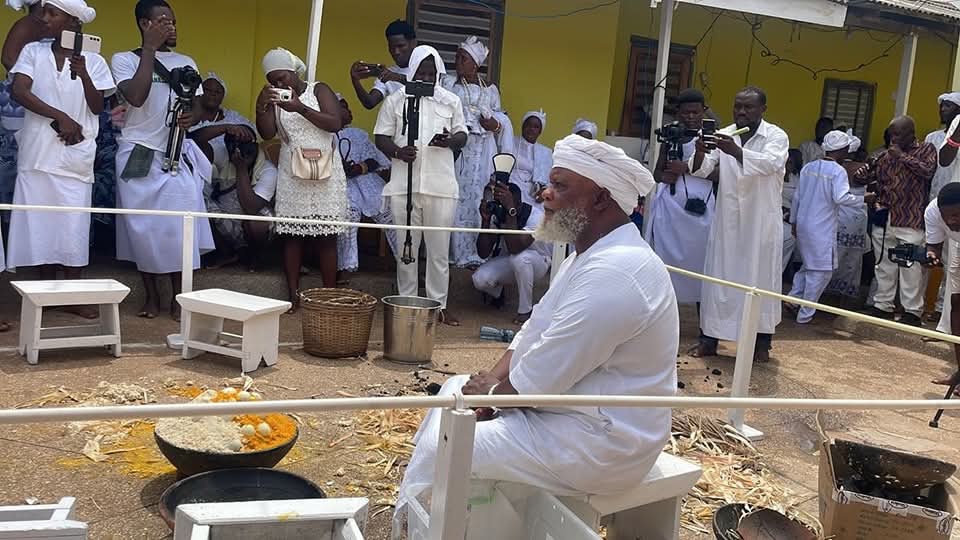
Year after year, the traditional authority of the Gborbu Wulomo-Shitse oversees sacred observances associated with the land. Among these is the preparation of Atobi, sacred corn sprinkled in accordance with tradition as part of the rites and their spiritual significance.

Advertisement

These practices are important expressions of the relationship between the people, their ancestors, their environment and their understanding of the spiritual world.

Wor Lumor Konor Nuumo Borketey Laweh Tsuru, the Gborbu Wulomo-Shitse and Spiritual Overlord of the GaDangme State, occupies a significant traditional role in the preservation and observance of these sacred customs.

His involvement reflects the importance of ensuring that heritage promotion proceeds with due regard for the traditional custodians, established rites and cultural protocols that give Angmu Te its deeper meaning.

Advertisement

The objective is to bring the spiritual, historical, academic and tourism dimensions together in a manner that respects tradition while opening new possibilities for the future.

WHY THE WORLD SHOULD PAY ATTENTION

The ambition to secure international heritage recognition for Angmu Te deserves serious consideration. Although UNESCO World Heritage inscription is a process requiring rigorous assessment against established criteria, authenticity, protection and management requirements, the pursuit itself can encourage valuable research, conservation and public engagement.

Advertisement

A successful heritage-development programme could create several opportunities for Nungua and Ghana, including:

– Tourism and international visibility: Attracting visitors, researchers, historians, cultural enthusiasts and international heritage organisations.
– Employment and local enterprise: Creating opportunities for tour guides, hospitality businesses, artisans, food vendors, transport operators and other local entrepreneurs.
– Youth education and cultural continuity: Helping young people understand GaDangme history, traditional institutions and ancestral heritage.
– Research and documentation: Encouraging universities, historians, archaeologists and cultural experts to investigate, document and preserve the story of Angmu Te.
– Investment and community development: Creating opportunities for partnerships, cultural infrastructure and responsible tourism.
– National and continental pride: Positioning Ghana and Africa more prominently in conversations about the preservation of indigenous heritage and the importance of African cultural knowledge.

These possibilities are worth exploring through careful planning, community participation and sustained collaboration.

Advertisement

A FESTIVAL BUILT ON PREPARATION AND COLLABORATION

The Dzenten Festival is not simply an occasion to gather, celebrate and disperse. It is an opportunity to give renewed life to a heritage story that deserves wider recognition.

Behind an initiative of this nature are research, consultations, institutional engagement, cultural preparation and the work required to bring diverse stakeholders around a common purpose.

Advertisement

The collaboration between Accra Metropolitan University and the Office of the Gborbu Wulomo-Shitse provides a platform for combining academic expertise with traditional knowledge. Such partnerships can help ensure that cultural promotion is informed by research, respectful of customary authority and beneficial to the community.

Nungua’s traditional institutions, including Oboade Notse King Odai Fio Welentsi III, the Nungua Mantse and President of the Greater Accra Regional House of Chiefs, alongside other traditional authorities and community stakeholders, have important roles to play in the broader conversation about preserving and promoting the area’s heritage.

The wider GaDangme traditional leadership also has an opportunity to support an initiative that can bring attention to the history, identity and cultural contributions of our people.

Advertisement

The participation and engagement of stakeholders can strengthen the festival’s impact and help ensure that its benefits extend beyond a single day.

THE GBORBU WULOMO-SHITSE: CUSTODIANSHIP AND COMMUNITY PROGRESS

Wor Lumor Konor Nuumo Borketey Laweh Tsuru, the Gborbu Wulomo-Shitse, represents a traditional institution whose responsibilities include the preservation of sacred customs and the protection of the spiritual heritage entrusted to it.

Advertisement

His involvement in this initiative should be understood within that context: the advancement of heritage preservation, the recognition of traditional knowledge and the pursuit of opportunities that can benefit Nungua and the GaDangme State.

Tradition and development need not stand in opposition. When handled with mutual respect, they can reinforce each other, ensuring that progress does not erase identity and that heritage remains relevant to contemporary society.

This is the opportunity before Nungua: to demonstrate that its ancestral heritage can be preserved with dignity while serving as a foundation for education, tourism, cultural exchange and economic opportunity.

Advertisement

1ST NOVEMBER 2026: A DATE TO ANTICIPATE

If you have not experienced the excitement of seeing your community’s heritage receive wider attention, 1st November 2026 presents a reason to look forward with anticipation.

The Dzenten Festival offers an opportunity to bring together traditional leaders, academics, cultural practitioners, dignitaries, residents and visitors from near and far in celebration of a heritage that belongs to Nungua and forms part of Ghana’s broader cultural story.

Advertisement

Imagine the possibilities when the history of Angmu Te is researched more deeply, its traditions are documented, its story is shared with the world and younger generations are encouraged to take pride in their inheritance.

That is the greater promise of this initiative.

The objective is not merely to organise a festival; it is to build a lasting platform for heritage recognition, cultural education and community advancement.

Advertisement

Let us therefore approach this historic undertaking with open minds, a shared sense of responsibility and a commitment to preserving what generations before us have entrusted to our care.

Nungua has a story worth telling. The GaDangme State has a heritage worth protecting. Ghana has a cultural legacy worth presenting to the world. And Africa has traditions whose significance deserves to be understood far beyond its shores.

Angmu Te is more than a rock. It is a reminder that our heritage carries stories capable of connecting our past to our future.

Advertisement

On 1st November 2026, let us celebrate that story, strengthen our collective commitment to its preservation and work together to ensure that the legacy of Nungua continues to shine.

DJENTEN FESTIVAL 2026 — PRESERVING OUR HERITAGE, CELEBRATING OUR IDENTITY, INSPIRING OUR FUTURE.

The story of Nungua belongs to its people. Its preservation is our shared responsibility.

Advertisement

Written by Elliot Borketey Bortey (EBB)

Advertisement
Continue Reading
Advertisement

Facebook

Featured

Nigeria1 week ago

IGP DISU HONOURS PIONEER POLICEWOMEN, LAUNCHES BOOK ON WOMEN IN POLICING

The Inspector-General of Police, IGP Olatunji Rilwan Disu, psc(+), NPM, on Tuesday, 13th October 2026, attended the public presentation and...
Lifestyle1 week ago

ANGМU TE: NUNGUA’S HERITAGE, THE GADANGME IDENTITY AND A WORLD OF POSSIBILITIES

As Nungua prepares to celebrate the Dzenten Festival on 1st November 2026 the world has an opportunity to rediscover a...

Events2 weeks ago

Warrior King Watches CEO Honoured with Innovative Excellence Award at HAPAwards 10th Anniversary 2026

Ghanaian luxury watchmaker Mr Patrick Amofah recognised at the 10th anniversary of the Hollywood and African Prestigious Awards, held at...
Music2 weeks ago

Kwasi Bobo Unveils New Single “Odasani” as He Sets Sights on a Global Audience

Ghanaian recording artiste Kwasi Bobo is pushing his musical ambitions beyond Ghana with the release of his latest single, “Odasani,”...
Lifestyle2 weeks ago

Helping Hand Global Inc. transforms Peniel Nursery through renovation project in honour of late father and founding leaders

Helping Hand Global Incorporated has renovated classrooms, a kitchen, a playground and an ICT laboratory at the Presbyterian Church of...

Lifestyle2 weeks ago

“My Vision Is to Take Locally Manufactured Footwear to International Markets” – Simon Quayson, CEO of Mr. Simon Classic Footwear

Ghanaian locally manufactured footwear brand Mr. Simon Classic Footwear is positioning itself for expansion into the international market, with its...
Local News2 weeks ago

Safety Gathering 3.0 Crowns New Champions at Goldfield Clubhouse, Tarkwa

Safety Gathering 3.0 lived up to its billing as a premium evening celebrating safety leadership, excellence in mentorship, and the...
Nigeria3 weeks ago

REIGNING WITH CHRIST IN MY KINGDOM BY HER MAJESTY, DR. JOSEPHINE DIETE-SPIFF ESQ, JP, QUEEN OF TWON BRASS KINGDOM, BAYELSA STATE, NIGERIA.

  (CONCLUSION)  Advertisement HEALING AND DELIVERANCE MINISTRY God called me into the ministry through a dream in 1999, after I...
News3 weeks ago

BOLIC and HOLYRINA Team Up on Inspirational New Song “Ɔbrɛ”

Life has a way of testing us. There are seasons when the road feels endless, the weight becomes heavy, and...

Showbiz3 weeks ago

Michael K. Okyere releases “Kyere Me Kwan”

Ghanaian artiste Michael K. Okyere has released his latest single, Kyere Me Kwan, a faith driven song that reflects on...

Advertisement

Trending