
CYBERDUCATION
Ghana, UK Deepen Cybersecurity Cooperation to Strengthen Digital Resilience

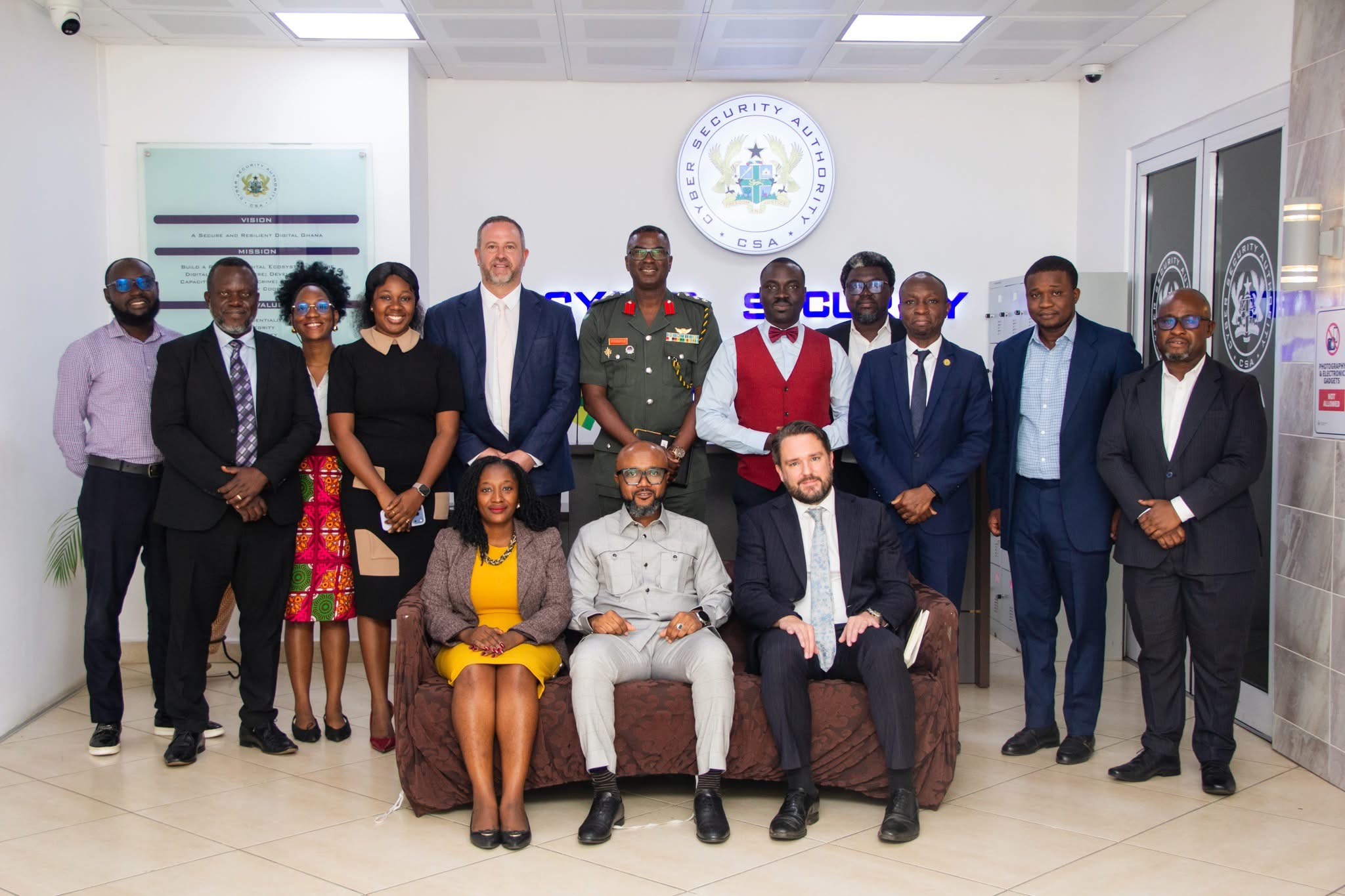
The Cyber Security Authority (CSA) is deepening its strategic partnership with the United Kingdom as Ghana steps up efforts to strengthen cybersecurity resilience, combat cyber-enabled crime and build a safer digital environment for citizens.

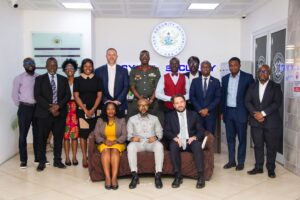
The latest engagement between the CSA and the British High Commission focused on strengthening UK–Ghana cybersecurity cooperation and identifying areas for greater collaboration in addressing emerging digital threats.
Key areas discussed included the Pall Mall Process, cyber-enabled crime and financial fraud, child online protection, cybersecurity capacity building and international cyber governance.
Advancing the Pall Mall Process
A major focus of the engagement was the Pall Mall Process, an international initiative aimed at promoting responsible behaviour and reducing risks associated with the development and use of commercially available cyber intrusion capabilities.
The discussions emphasised the importance of increasing African participation in the Pall Mall Process and ensuring that its principles translate into practical measures that contribute to cybersecurity while safeguarding human rights.
For Ghana, greater African participation in international cybersecurity initiatives presents an opportunity to ensure that the continent’s perspectives, priorities and experiences are reflected in global discussions on emerging cyber threats and technologies.
The CSA stressed the need for international cybersecurity principles to move beyond policy discussions and contribute to tangible actions that strengthen digital security and protect fundamental rights.

Tackling cyber-enabled crime and financial fraud
The engagement also explored cooperation in tackling cyber-enabled crime and financial fraud, two growing challenges associated with the increasing use of digital technologies.
As digital platforms and financial services become more widely used, cybercriminals continue to exploit technological vulnerabilities to target individuals, businesses and institutions.
Strengthening international cooperation is therefore considered critical to improving the ability of countries to prevent, detect and respond to cybercrime and protect citizens from digitally enabled financial fraud.
Closer collaboration between Ghana and the UK could support knowledge sharing, capacity building and coordinated approaches to addressing cyber threats that increasingly cross national borders.
Strengthening child online protection
Child online safety emerged as another important area of cooperation. The discussions highlighted opportunities to strengthen partnerships aimed at protecting children from online risks while promoting safer and more responsible use of digital platforms.
The CSA and the British High Commission also explored opportunities to expand cybersecurity awareness among secondary school students.
Such initiatives could help young people develop practical knowledge about online safety, responsible digital behaviour, privacy, cyberbullying, scams and other emerging threats they may encounter in the digital environment.
The focus on young people reflects the growing importance of equipping the next generation with the knowledge and skills required to navigate an increasingly digital society safely.
Building cybersecurity capacity
Cybersecurity capacity building was also identified as an important area for continued Ghana–UK cooperation.
As cyber threats become more sophisticated, countries require not only strong policies and institutions but also a skilled workforce capable of identifying, preventing and responding to cyber incidents.
Partnerships between Ghana and the UK could therefore contribute to strengthening technical expertise, institutional capacity and knowledge exchange within Ghana’s cybersecurity ecosystem.
The discussions also highlighted the importance of regional cooperation across Africa, recognising that cybersecurity threats do not respect national borders and often require coordinated responses.
Ghana’s role in Africa’s cybersecurity landscape
The engagement comes as Ghana continues to strengthen its position within Africa’s cybersecurity landscape.
The country’s efforts to develop cybersecurity institutions, strengthen regulation, improve public awareness and enhance international cooperation have positioned cybersecurity as an important component of its broader digital development agenda.
The CSA’s continued engagement with international partners is expected to support Ghana’s efforts to build a more resilient digital ecosystem while contributing to wider African cybersecurity initiatives.
Greater regional collaboration could also help African countries share knowledge, strengthen cybercrime response mechanisms and develop coordinated approaches to emerging digital threats.
Towards a safer digital future
The latest Ghana–UK engagement underscores the growing importance of international partnerships in addressing the complex cybersecurity challenges confronting countries in an increasingly interconnected digital world.
From cyber-enabled financial crime and child online safety to international cyber governance and capacity building, the areas discussed demonstrate that cybersecurity requires cooperation across governments, institutions, communities and international partners.
For Ghana, strengthening its partnership with the UK provides an opportunity to deepen expertise, expand capacity and ensure that global cybersecurity discussions translate into practical outcomes for citizens.
As the CSA continues to advance Ghana’s cybersecurity agenda, strong international partnerships, practical action and greater African collaboration will remain critical to building a secure, resilient and rights-respecting digital ecosystem.
The broader objective is clear: to ensure that Ghana’s digital transformation is accompanied by stronger protection for citizens, institutions and critical systems, while contributing to a safer digital future for Africa and beyond.
Source: Sintim Media








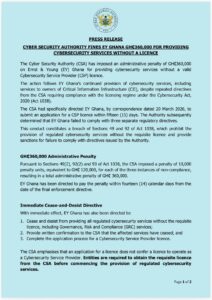
The Cyber Security Authority (CSA) has imposed an administrative penalty of GH¢360,000 on Ernst & Young (EY) Ghana for providing regulated cybersecurity services without a valid Cybersecurity Service Provider (CSP) license.

According to a CSA statement dated August 18, 2026, EY Ghana continued to provide cybersecurity services, including services to owners of Critical Information Infrastructure (CII), despite directives from the Authority to comply with Ghana’s cybersecurity licensing requirements.
The CSA said it directed EY Ghana on March 20, 2026, to apply for a CSP licence within 15 days. However, the Authority determined that the company failed to comply with three separate regulatory directives.
The breaches were deemed violations of Sections 49 and 92 of the Cybersecurity Act, 2020 (Act 1038). The CSA subsequently imposed 10,000 penalty units, equivalent to GH¢120,000, for each of the three instances of non-compliance, bringing the total penalty to GH¢360,000.
EY Ghana has been ordered to pay the penalty within 14 calendar days of the final enforcement directive. The CSA has also issued an immediate cease-and-desist order, requiring the company to stop providing regulated cybersecurity services, including Governance, Risk and Compliance (GRC) services, until it obtains the required licence.
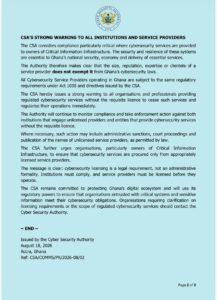
The Authority further clarified that merely submitting a licence application does not permit an organisation to operate as a CSP. Providers must obtain the licence before offering regulated cybersecurity services.
CSA issues warning
The CSA used the enforcement action to warn organisations and professionals providing cybersecurity services without the required licence.
It stressed that no organisation is exempt from Ghana’s cybersecurity laws because of its size, reputation, expertise or clientele. This is particularly important for service providers working with Critical Information Infrastructure, whose protection is considered essential to Ghana’s national security, economy and delivery of vital services.
The Authority has directed all unlicensed cybersecurity service providers to immediately cease regulated activities and regularise their operations. It also warned that further violations could attract administrative sanctions, court proceedings and, where legally permitted, publication of the names of unlicensed providers.
The CSA has urged organisations, particularly owners of Critical Information Infrastructure, to engage only licensed cybersecurity service providers.
The enforcement action reinforces the CSA’s position that cybersecurity licensing is a legal requirement, rather than merely an administrative formality.
Source: Sintim Media | CSA


IGP DISU HONOURS PIONEER POLICEWOMEN, LAUNCHES BOOK ON WOMEN IN POLICING
The Inspector-General of Police, IGP Olatunji Rilwan Disu, psc(+), NPM, on Tuesday, 13th October 2026, attended the public presentation and...


ANGМU TE: NUNGUA’S HERITAGE, THE GADANGME IDENTITY AND A WORLD OF POSSIBILITIES
As Nungua prepares to celebrate the Dzenten Festival on 1st November 2026 the world has an opportunity to rediscover a...


Warrior King Watches CEO Honoured with Innovative Excellence Award at HAPAwards 10th Anniversary 2026
Ghanaian luxury watchmaker Mr Patrick Amofah recognised at the 10th anniversary of the Hollywood and African Prestigious Awards, held at...


Kwasi Bobo Unveils New Single “Odasani” as He Sets Sights on a Global Audience
Ghanaian recording artiste Kwasi Bobo is pushing his musical ambitions beyond Ghana with the release of his latest single, “Odasani,”...


Helping Hand Global Inc. transforms Peniel Nursery through renovation project in honour of late father and founding leaders
Helping Hand Global Incorporated has renovated classrooms, a kitchen, a playground and an ICT laboratory at the Presbyterian Church of...


“My Vision Is to Take Locally Manufactured Footwear to International Markets” – Simon Quayson, CEO of Mr. Simon Classic Footwear
Ghanaian locally manufactured footwear brand Mr. Simon Classic Footwear is positioning itself for expansion into the international market, with its...


Safety Gathering 3.0 Crowns New Champions at Goldfield Clubhouse, Tarkwa
Safety Gathering 3.0 lived up to its billing as a premium evening celebrating safety leadership, excellence in mentorship, and the...


REIGNING WITH CHRIST IN MY KINGDOM BY HER MAJESTY, DR. JOSEPHINE DIETE-SPIFF ESQ, JP, QUEEN OF TWON BRASS KINGDOM, BAYELSA STATE, NIGERIA.
(CONCLUSION) Advertisement HEALING AND DELIVERANCE MINISTRY God called me into the ministry through a dream in 1999, after I...


BOLIC and HOLYRINA Team Up on Inspirational New Song “Ɔbrɛ”
Life has a way of testing us. There are seasons when the road feels endless, the weight becomes heavy, and...


Michael K. Okyere releases “Kyere Me Kwan”
Ghanaian artiste Michael K. Okyere has released his latest single, Kyere Me Kwan, a faith driven song that reflects on...
IGP DISU HONOURS PIONEER POLICEWOMEN, LAUNCHES BOOK ON WOMEN IN POLICING
ANGМU TE: NUNGUA’S HERITAGE, THE GADANGME IDENTITY AND A WORLD OF POSSIBILITIES
Warrior King Watches CEO Honoured with Innovative Excellence Award at HAPAwards 10th Anniversary 2026
Kwasi Bobo Unveils New Single “Odasani” as He Sets Sights on a Global Audience
Helping Hand Global Inc. transforms Peniel Nursery through renovation project in honour of late father and founding leaders

Central Music Awards 2026: Full List of Nominees

REIGNING WITH CHRIST IN MY KINGDOM BY HER MAJESTY, DR. JOSEPHINE DIETE-SPIFF ESQ, JP, QUEEN OF TWON BRASS KINGDOM, BAYELSA STATE, NIGERIA.

A DISTINGUISHED EXIT: Construction Division Celebrates Engr. Bello Kabir as He Retires from FCT Civil Service After 34 Years of Meritorious Service
Kwasi Bobo Unveils New Single “Odasani” as He Sets Sights on a Global Audience
Safety Gathering 3.0 Crowns New Champions at Goldfield Clubhouse, Tarkwa
-
 Awards3 weeks ago
Central Music Awards 2026: Full List of Nominees
-
 Nigeria4 weeks ago
REIGNING WITH CHRIST IN MY KINGDOM BY HER MAJESTY, DR. JOSEPHINE DIETE-SPIFF ESQ, JP, QUEEN OF TWON BRASS KINGDOM, BAYELSA STATE, NIGERIA.
-
 Nigeria4 weeks ago
A DISTINGUISHED EXIT: Construction Division Celebrates Engr. Bello Kabir as He Retires from FCT Civil Service After 34 Years of Meritorious Service
-
Music2 weeks ago
Kwasi Bobo Unveils New Single “Odasani” as He Sets Sights on a Global Audience
-
Local News3 weeks ago
Safety Gathering 3.0 Crowns New Champions at Goldfield Clubhouse, Tarkwa
-

 Music3 weeks ago
Lhord Verses Showcases His Lyrical Prowess in New ‘LeBron Flow’ Freestyle
-
Nigeria3 weeks ago
REIGNING WITH CHRIST IN MY KINGDOM BY HER MAJESTY, DR. JOSEPHINE DIETE-SPIFF ESQ, JP, QUEEN OF TWON BRASS KINGDOM, BAYELSA STATE, NIGERIA.
-

 Nigeria4 weeks ago
OBA OLUGBENLE ATTENDS NIGERIA’S 66TH INDEPENDENCE ANNIVERSARY THANKSGIVING SERVICE