
Nigeria
From Presidential Recognition in 2022 to Humanitarian Service in 2026: Mallam Musa Umar Yashi and the Unfinished Mission of Humanity

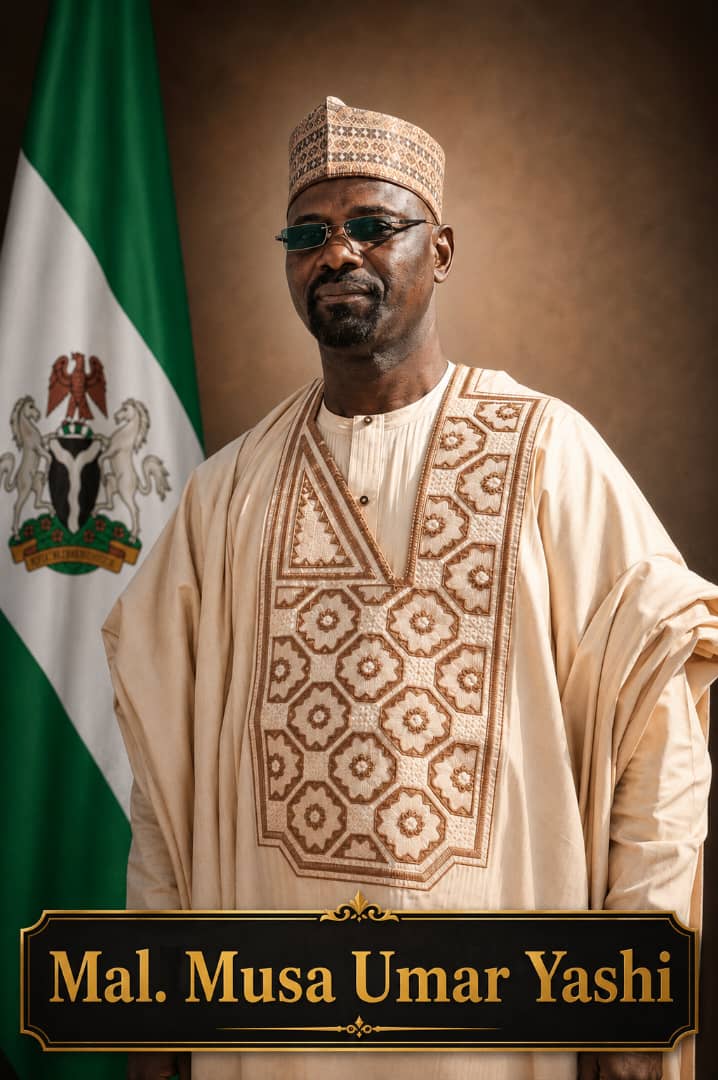
Contributed by Engr. Maidabino
Public Affairs Commentator
Four years after Nigeria recognised his humanitarian excellence, the mission continues through compassion, service and the restoration of human dignity.
As the world comes together once again to commemorate World Humanitarian Day 2026 (WHD 2026), the occasion provides an opportunity not only to honour humanitarian workers across the globe, but also to reflect on individuals whose lives have become synonymous with compassion, service and the defence of human dignity.
In moments like this, we are reminded that humanitarianism is not a seasonal gesture, but a lifelong commitment to people who need hope the most.
For Nigeria, and particularly for the North-East, one name that deserves to be remembered in this conversation is Malam Musa Umar Yashi, FCAI. He is a globally recognised humanitarian, philanthropist, seasoned administrator, respected statesman and one of the emerging leaders whose influence continues to be measured not merely by the offices he has occupied, but by the lives he has touched.
Malam Musa Umar Yashi, FCAI.
His story speaks to a leadership that prioritises people over protocol, and service over spectacle.
And there is a remarkable point of reference in his humanitarian journey. It was World Humanitarian Day 2022 (WHD 2022).
Four years ago, Malam Musa Umar Yashi received national recognition as Nigeria’s Humanitarian Person of the Year 2022, in a Presidential recognition associated with the 2022 World Humanitarian Day celebrations. Contemporary reports from that period recorded the recognition as a presidential choice and national acknowledgement of his humanitarian contribution.
That recognition is worth remembering today, not simply because of the prestige attached to an award, but because of what has happened since. The award did not mark the end of the journey. It became another chapter in it.
Four years later, as the global community marks World Humanitarian Day 2026, the story of Malam Musa Umar Yashi continues to evolve around the same fundamental principle that has defined his public life for decades: service to humanity.

Awards can sometimes be forgotten after the ceremonies are over. Plaques can gather dust. Titles can fade with time.
But a humanitarian legacy is different, because its true measure is found in what happens after the applause. For Malam Musa Umar Yashi, the significance of the 2022 recognition lies in the fact that it came as an acknowledgement of a humanitarian culture that was already deeply rooted in his life.
His commitment to vulnerable people did not begin with an appointment. It did not begin with a government office. It did not begin with a public title.
It evolved over decades through personal interventions, community support and a consistent willingness to stand with people whose circumstances often make them invisible to society. That is why the 2022 recognition can be viewed not merely as an award, but as a national affirmation of a philosophy of service that predated any office.
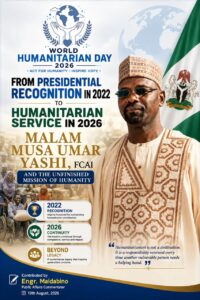
Today, four years after that national recognition, the humanitarian story continues. Across communities, humanitarian interventions associated with Malam Musa Umar Yashi have continued to reach vulnerable families, women, orphans, elderly persons, persons with disabilities and other people facing difficult circumstances.
The recent large-scale distribution of food items across Bauchi State and the North-East provides another illustration of this continuing commitment. Thousands of food items, alongside other consumable and non-consumable items, have been distributed to people and groups in need.
But the real story is not the items. The real story is the human being behind the need.
Behind every bag of food is a household that may be struggling to put a meal on the table. Behind every intervention is a mother trying to provide for her children.
Behind every package received by an elderly person is the reassurance that somebody still remembers. Behind every item given to an orphan is a message that vulnerability should never mean abandonment.
Behind every intervention reaching a person with disability is a reminder that inclusion must be demonstrated, not merely spoken about. This is where humanitarianism moves beyond statistics and becomes human.
Malam Musa Umar Yashi currently serves as Executive Director for Humanitarian Affairs at the North-East Development Commission, NEDC. The Commission’s records his long public-service background and identifies him in that capacity.
But his humanitarian identity should not be reduced to his current office, because that distinction is important.
There is the public servant who rose through the ranks of Nigeria’s civil service and developed a reputation as a seasoned administrator. There is the administrator whose experience brought him to senior national responsibilities.
And there is the humanitarian whose personal commitment to vulnerable Nigerians has continued alongside his professional journey. The convergence of these three dimensions has produced a distinctive leadership profile: administrative competence combined with a human face.
His career in public service has given him institutional experience, while his humanitarian activities have kept him connected to the realities faced by ordinary people. That combination is particularly significant in a region where humanitarian needs are complex and where recovery requires not only policies and institutions, but empathy, patience and an understanding of communities.
Long before his current role, Malam Musa Umar Yashi built a substantial career from Bauchi State civil service, and within the Federal Government of Nigeria’s civil service, rising through the ranks to the esteemed position of Director.
That journey matters because it demonstrates that his story is not built solely around philanthropy. He is also an administrator, a man shaped by public institutions, procedure, responsibility and years of national service.
His subsequent return to national service through humanitarian leadership therefore represents a continuation of public responsibility from another dimension. Where administration provides structure, humanitarianism provides purpose.
Where policy establishes direction, compassion reminds leadership of the people for whom those policies exist. And where institutions provide mechanisms, individuals such as Malam Musa Umar Yashi can help ensure that the human being remains at the centre.
Perhaps one of the most defining aspects of Malam Musa Umar Yashi’s public image is his reputation as a detribalized Nigerian. His humanitarian outlook is not confined to one ethnic group, one community or one social category.
His interventions have reached women, persons with disabilities, orphans, elderly people, vulnerable families, NGOs, community organisations and others whose needs cut across the boundaries of tribe, status and background.
This is important in contemporary Nigeria. At a time when public discourse can sometimes become narrowly defined by ethnicity, region or identity, humanitarian service provides another language: humanity.
The hungry person does not ask whether the food came from someone of the same tribe. The orphan does not ask about political affiliation before accepting a helping hand. The elderly do not measure compassion by geography.
Human suffering is universal. And so should be compassion. This is why the description of Malam Musa Umar Yashi as a detribalized Nigerian carries significance beyond mere praise. It speaks to a philosophy that places human dignity above sectional considerations.
Perhaps this is the most important connection between 2022 and 2026. 2022 was recognition. 2026 is continuity.
The Presidential recognition established that his humanitarian contribution had attracted national attention. The years that followed provide the opportunity to ask the more important question: Did the recognition change the commitment?
The evidence of continuing humanitarian interventions suggests a story of persistence rather than retreat. And that is what makes the journey compelling.
Some people become humanitarian icons because of one extraordinary intervention. Others build their humanitarian identity slowly, through years of repeated acts of service. Malam Musa Umar Yashi belongs to the second category. His story is one of continuity.
In today’s Nigeria, leadership is increasingly judged by visibility. But true humanitarian leadership is often measured differently.
It is measured by reach. By consistency. By inclusion. By the ability to identify people who might otherwise be overlooked. And ultimately, by the dignity restored to those who receive assistance.
That is why the humanitarian profile of Malam Musa Umar Yashi extends beyond his official designation. His supporters describe him as a philanthropist. His colleagues recognise him as a seasoned administrator.
Communities see him as a benefactor. And the humanitarian sector recognises the importance of people who remain willing to stand with vulnerable populations. These descriptions converge around one larger identity: a man whose public service is inseparable from his concern for humanity.
World Humanitarian Day 2026 comes at a difficult time globally. Humanitarian organisations continue to warn about the dangers confronting civilians and aid workers, while conflicts and humanitarian crises continue to place millions of people at risk.
In such an environment, the humanitarian ideal cannot remain an abstract concept. It has to be lived. It has to be demonstrated. It has to reach people. And it has to continue even when there are no cameras, ceremonies or awards.
That is perhaps the greatest lesson from the journey of Malam Musa Umar Yashi. In 2022, Nigeria recognised him. In 2026, his humanitarian journey continues to provide the context in which that recognition can be remembered.
The award belongs to history. The service belongs to the present. And the humanitarian mission belongs to the future.
For Malam Musa Umar Yashi, FCAI, the story therefore remains unfinished. Because humanitarianism is not a destination.
It is a responsibility that must be renewed every time another vulnerable person needs a helping hand, every time another family needs relief, and every time human dignity needs someone willing to stand in its defence.
And perhaps that is the most fitting way to remember the humanitarian on World Humanitarian Day 2026: not simply as the man Nigeria honoured in 2022, but as the humanitarian whose work continues to give meaning to that honour.
From recognition to responsibility. From responsibility to continuity. From continuity to legacy. That is the unfolding story of Malam Musa Umar Yashi, FCAI.
In conclusion, the Executive Director for Humanitarian Affairs at the North-East Development Commission, NEDC, Malam Musa Umar Yashi, FCAI, rose from humble beginnings in Yashi, Alkaleri Local Government Area of Bauchi State.
He remains a proud son of the North-East, a descendant of the old Northern Region, and a patriotic Nigerian whose humanitarian commitment has earned recognition beyond his immediate community and across the wider humanitarian space!
May his continued rise to stardom translate into immense benefits for humanity, for Nigeria, for Nigerians, and for the world at large.



IGP DISU HONOURS PIONEER POLICEWOMEN, LAUNCHES BOOK ON WOMEN IN POLICING
The Inspector-General of Police, IGP Olatunji Rilwan Disu, psc(+), NPM, on Tuesday, 13th October 2026, attended the public presentation and...

ANGМU TE: NUNGUA’S HERITAGE, THE GADANGME IDENTITY AND A WORLD OF POSSIBILITIES
As Nungua prepares to celebrate the Dzenten Festival on 1st November 2026 the world has an opportunity to rediscover a...


Warrior King Watches CEO Honoured with Innovative Excellence Award at HAPAwards 10th Anniversary 2026
Ghanaian luxury watchmaker Mr Patrick Amofah recognised at the 10th anniversary of the Hollywood and African Prestigious Awards, held at...


Kwasi Bobo Unveils New Single “Odasani” as He Sets Sights on a Global Audience
Ghanaian recording artiste Kwasi Bobo is pushing his musical ambitions beyond Ghana with the release of his latest single, “Odasani,”...

Helping Hand Global Inc. transforms Peniel Nursery through renovation project in honour of late father and founding leaders
Helping Hand Global Incorporated has renovated classrooms, a kitchen, a playground and an ICT laboratory at the Presbyterian Church of...


“My Vision Is to Take Locally Manufactured Footwear to International Markets” – Simon Quayson, CEO of Mr. Simon Classic Footwear
Ghanaian locally manufactured footwear brand Mr. Simon Classic Footwear is positioning itself for expansion into the international market, with its...

Safety Gathering 3.0 Crowns New Champions at Goldfield Clubhouse, Tarkwa
Safety Gathering 3.0 lived up to its billing as a premium evening celebrating safety leadership, excellence in mentorship, and the...

REIGNING WITH CHRIST IN MY KINGDOM BY HER MAJESTY, DR. JOSEPHINE DIETE-SPIFF ESQ, JP, QUEEN OF TWON BRASS KINGDOM, BAYELSA STATE, NIGERIA.
(CONCLUSION) Advertisement HEALING AND DELIVERANCE MINISTRY God called me into the ministry through a dream in 1999, after I...


BOLIC and HOLYRINA Team Up on Inspirational New Song “Ɔbrɛ”
Life has a way of testing us. There are seasons when the road feels endless, the weight becomes heavy, and...


Michael K. Okyere releases “Kyere Me Kwan”
Ghanaian artiste Michael K. Okyere has released his latest single, Kyere Me Kwan, a faith driven song that reflects on...
IGP DISU HONOURS PIONEER POLICEWOMEN, LAUNCHES BOOK ON WOMEN IN POLICING
ANGМU TE: NUNGUA’S HERITAGE, THE GADANGME IDENTITY AND A WORLD OF POSSIBILITIES
Warrior King Watches CEO Honoured with Innovative Excellence Award at HAPAwards 10th Anniversary 2026
Kwasi Bobo Unveils New Single “Odasani” as He Sets Sights on a Global Audience
Helping Hand Global Inc. transforms Peniel Nursery through renovation project in honour of late father and founding leaders

Central Music Awards 2026: Full List of Nominees

REIGNING WITH CHRIST IN MY KINGDOM BY HER MAJESTY, DR. JOSEPHINE DIETE-SPIFF ESQ, JP, QUEEN OF TWON BRASS KINGDOM, BAYELSA STATE, NIGERIA.

A DISTINGUISHED EXIT: Construction Division Celebrates Engr. Bello Kabir as He Retires from FCT Civil Service After 34 Years of Meritorious Service

Lhord Verses Showcases His Lyrical Prowess in New ‘LeBron Flow’ Freestyle
Kwasi Bobo Unveils New Single “Odasani” as He Sets Sights on a Global Audience
-
 Awards3 weeks ago
Central Music Awards 2026: Full List of Nominees
-
 Nigeria3 weeks ago
REIGNING WITH CHRIST IN MY KINGDOM BY HER MAJESTY, DR. JOSEPHINE DIETE-SPIFF ESQ, JP, QUEEN OF TWON BRASS KINGDOM, BAYELSA STATE, NIGERIA.
-
 Nigeria3 weeks ago
A DISTINGUISHED EXIT: Construction Division Celebrates Engr. Bello Kabir as He Retires from FCT Civil Service After 34 Years of Meritorious Service
-
 Music3 weeks ago
Lhord Verses Showcases His Lyrical Prowess in New ‘LeBron Flow’ Freestyle
-
Music1 week ago
Kwasi Bobo Unveils New Single “Odasani” as He Sets Sights on a Global Audience
-
Local News2 weeks ago
Safety Gathering 3.0 Crowns New Champions at Goldfield Clubhouse, Tarkwa
-
Nigeria2 weeks ago
REIGNING WITH CHRIST IN MY KINGDOM BY HER MAJESTY, DR. JOSEPHINE DIETE-SPIFF ESQ, JP, QUEEN OF TWON BRASS KINGDOM, BAYELSA STATE, NIGERIA.
-

 Events3 weeks ago
Ghana, Sierra Leone and Germany Set for Cultural Exchange Through GERGHANSAL 2027